Recipes and Tips posted in February, 2008
Steaming your food on cooking rice
February 29th, 2008 by WeryNice Editor - Register for printable Version
Do you know that steam dishes can be steamed on cooking rice? Eg steam fish, water egg, pork ribs, chicken etc.. In fact it gives the dish additional fragrance of the rice, and the rice the fragrance of the dish.
How to do it? When cooking your rice (either using rice cooker or pot over stove), when the rice is exposed with bubbles bubbling out of the surface, you can simply put the steaming plate or bowl directly on the rice (don’t worry, it will not sink in, only slightly), cover the lid and let the rice to cook complete. Do not open the lid. Leave it covered for 10 more minutes after the rice is cooked or you have turned off the flame.
Back to index.
Category: Cooking Tips |
Discuss (No Comments) »
How to cook rice without a rice cooker
February 29th, 2008 by WeryNice Editor - Register for printable Version
Our life is made easy by technology, and cooking rice is made easy with rice cooker. Just add the right amount of water (see url) ,and on the power, and you get your rice in 20-30 mins. But what if you are in situation when you don’t have a rice cooker?
Here is how you do it. Prepare the rice and water as usual (see url) inside a cooking pot with cover or lid. It will be good if the lid is made of see through glass so that you can see without lifting the lid. Put the pot on stove and leave it to boil. Once the water started to boil, turn down the flame to low and continue to let it boil. When the water level is now below the surface of the rice, ie you will be seeing the half cooked rice exposed with lots of bubbles bubbling out of the surface, this is the time you have to lower the flame to the minimum and this will be the time the rice absorbed all the moisture and get cooked. Once completely dry, off the flame and best leave the lid closed for another 10 minutes. Be careful that if you did not turn off the flame in time, you might burn the bottom. But rice cooked in this way always leaves behind a layer of hardened rice crust sticking the bottom of the pot. This is normal, and some people like the slightly burnt fragrance of the rice, and some Chinese recipes deep fry this crust and make it into a dish.
Back to index.
Category: Cooking Tips |
Discuss (3 Comments ) »
How much water to add in cooking rice
February 29th, 2008 by WeryNice Editor - Register for printable Version
When comes to cooking rice, the big question is how much water should I put? This is important as most of the water are absorbed by the rice itself and a small portion is evaporated.
Here is a guide. After rinsing the rice clean (please rinse it a few times) put the rice in the cooking pot and add water to cover and above the level of the rice. Use your index finger, stick it vertical down to the bottom of the pot, and using your thump resting against your index finger, adjust until the tip of the thump touches the rice. This will give you the depth of the rice. Then with the thump still against the index finger, lift up the index finger so that the tip just touches the rice. Now, the tip of your thump must be just touching the surface of the water. In short, the depth of the rice is equal to the depth of the water. Now if you like the rice to be softer and fluffy, add a little more (up to 50% more depth), or the rice to be harder, then reduce it just a little (up to 20%). However for brown rice, it tends to be harder in nature, and you could double the water amount to make it a soft and fluffy.
Back to index.
Category: Cooking Tips |
Discuss (3 Comments ) »
Steam water egg (蒸水蛋)
February 29th, 2008 by WeryNice Editor - Register for printable Version
Ingredients
- 2 chicken eggs
- 1 salted duck eggs (optional, can be replaced with 1 chicken egg)
- 1 century egg (optional)
- 50-100 grams minced pork
- 1/3 teaspoon salt
- dash of white pepper (grounded)
- water
Method
- Remove the husk of the salted egg and century egg.
- Peel the century egg and cut into small pieces
- Crack the salted eggs and chicken eggs into a steaming bowl. While cracking the chicken egg, at eat keep one of the egg shell as complete a whole egg as possible, by cracking only 1 end of the egg to peel off a small hole to pour out the egg contents.
- Cut the salted egg yolk into smaller pieces.
- Whip the eggs lightly.
- Using the empty egg shell in step 3, measure 3 eggs shell full of water and pour into and mixed with the eggs. Whip lightly.
- Add in the minced pork, and century egg.
- Add in salt if salted egg is not used, and do not add salt when salted egg is used. Add in the grounded pepper.
- Stir until the minced pork, century egg are evenly in suspension in the egg.
- Cover the bowl, and if the bowl does not comes with a cover, use PE wrap to cover it up. This is important to prevent the surface to be rough and full of pox mark if the steam directly over-cook the surface.
- Steam in low heat for 10 mins.
- Optional, after steaming, you can put some sesame oil and soy sauce on the steam egg.
- Serve hot.
Back to index.
Category: Egg, Recipes |
Discuss (No Comments) »
How to choose a chinese cleaver or chopping knife
February 26th, 2008 by WeryNice Editor - Register for printable Version
Having a good Chinese cleaver (菜刀) is an important part of Chinese cooking. Unlike western cooking that differentiate types of knife for different purpose, Chinese uses the cleaver for almost any form of food processing. It can be used to cut, slice, chop, minced, smash, skin, tenderize etc. A good cleaver has a the following characteristic.
- Right weight (not too heavy that tired you out, or too light that you cannot control the cutting action)
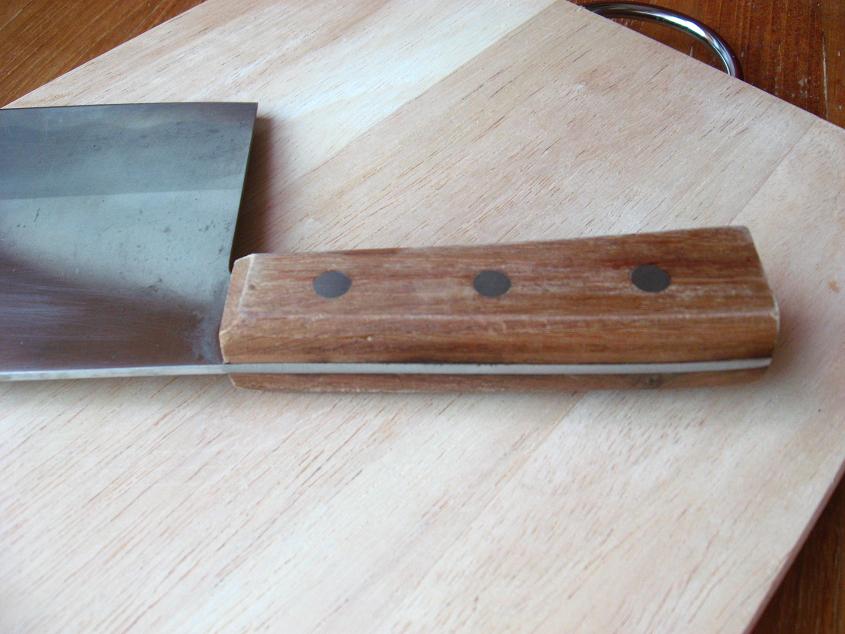
- Weight balance so that it does not strain the wrist and have better control. You should get knife that the same piece of metal extends through the length of the handle, with rivets securing the wooden handle to the blade. (See the picture). This will means that you are in fact holding on the blade itself, giving you a good sense of control on the blade.
- Very sharp, so that a cutting action down will cut the food without slipping. It is very important safety feature, as your fingers will be just next to the blade, and the blade slipping off the intended cutting position will put your fingers at risk. This sounds contrary that people are afraid that their knife is too sharp and they may cut themselves, but the fact is just the opposite.
- Blade is slightly curved.
- The flat surface of the blade is not exactly flat, and allow air to sip in between the blade and the food. This will prevent the vacuum effect, for example the carrot slices stuck on the blade when you slice through it.
Back to index.
Category: Cooking Tips |
Discuss (No Comments) »